Showing posts with label photography. Show all posts

Friday, April 19, 2013

Meeting and Greeting


I imagine my friendships as a spider’s web. Strands reach out in different directions; some towards college, others towards London or other parts of the country. A few have to stretch across oceans and bypass countries or continents to reach bloggers in America or Australia. Occasionally the horizontal skeins join one friend to another as lives overlap, often in unexpected ways. For me, the existence of this disparate collection of individuals and social spheres is a continual source of pleasure.
I’m always looking to add further threads to the web. Each unfurls the possibility of something new – another person to talk to, work with, enjoy the company of. They arise in a number of ways. The most obvious is mutual acquaintances, either introduced in person or recommended by a friend. A few were lucky chance encounters on residential courses or during events. Many have been found through London Fashion Week, with several street style photographers and other individuals met across the cobbles. Recently I’ve had the privilege to meet two bloggers slightly younger than me in separate cities, after long strings of emails. In both instances it was delight to move from computer screen to face-to-face encounter.
Such a diverse range of social interactions proves the irrelevance of age. Exchanges take place with people from fourteen to sixty-plus and carry a common theme – curiosity about and interest in other human beings. There’s a phrase that encapsulates this for me, taken from E.M Forster’s ‘Howards End’: “Only connect.” I most value the friendships that cut through the shallows and allow for this sense of connection – of conversation and debate, shared interests and contrasting opinions.
Talk between old friends has a different context than that of new acquaintances. One is characterized by ease and familiarity, the other often revolves around discovery. To find such new encounters, sometimes you have to take a plunge – be the brave one by igniting conversation with the person sitting next to you.
Then there are the other approaches demanded by pursuits such as street style photography. I experienced a nervous flutter on waylaying well-dressed individuals for Oxfam at Hay Festival last summer. Despite brandishing my camera, it still took a deep breath of courage to ask if I could photograph the passersby whose shoes, layers or smiling eyes caught my attention.
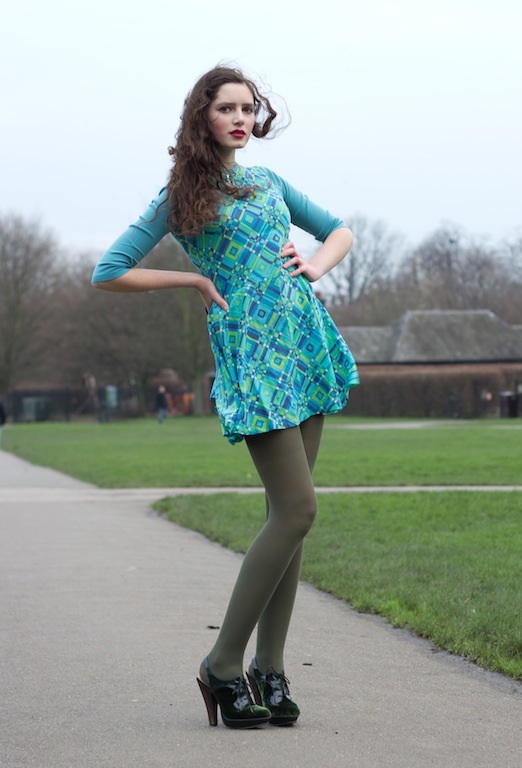
With photographer Fred however, I was in front of the camera for the images above. I met him after someone I know mentioned several times that he would “have to” get us to do some work together. I followed it up and several weeks later we met on a freezing afternoon at the top of Primrose Hill. I had little idea what he looked like, trusting instead that he would recognize me. His camera was a good indicator though. We chatted between shots, me taking very gentle steps in the green Office heels as we crisscrossed paths and chose suitable benches. A quick removal of the coat to reveal the sixties dress beneath was chilly enough to require a warm pot of tea afterwards. We discussed aspirations, inspirations, respective A' Levels and Cindy Sherman. As I walked back through the ever-darkening afternoon I paid special interest to the people around me: the dog walkers, the families, the joggers, the tourists, the couples, the lone strollers. Each undoubtedly had their own web of threads spinning out their daily encounters. 

You can see more of Fred's work here. 

Sunday, April 14, 2013

People Take Pictures of Each Other


It’s strange to think about how recent an invention the Internet is. The emails, notifications, feeds, coverage and images that take up much of the day are all comparatively recent developments. Looking back to snapshots of my mum’s teenage years is to peer through the window and witness a different view. Not necessarily a better or a worse one, but certainly distinct from this screen-filled modern life.
The Internet changes patterns - of product consumption, access to information, ways of communication, on and on it goes. Pick a topic, any topic, and we could probably discuss the impact of the Internet on it. Fashion is a readily available example. Style blogging is still young. So is the concept of online shopping. It wasn’t that long ago that Net-a-Porter was merely a tissue-wrapped whisper in Natalie Massenet’s ear. Growth has not just been rapid, but rocket-like. One of the most visible examples of fashion’s constant expansion and alteration is street style. The streets are a longstanding location. Both Norman Parkinson and Rico Puhlman enjoyed using them in fashion shoots, while Henri Cartier-Bresson netted and preserved the human variety he found there on rolls of film. But although Bill Cunningham has been snatching shots of the well dressed from the seventies onwards, it has only been in the last five years or so (and perhaps the last three for serious coverage) that street style has taken flight.
The bird analogy is fitting, for Suzy Menkes wrote an opinion piece during the recent fashion month that placed what she perceived to be respectable ‘crows’ in opposition to brash ‘peacocks.’ Her similes condensed down to editors versus exhibitionists. I have a variety of conflicting views on the issue, as I will readily admit the literal over-saturation of the streets with people outside each venue, whilst also acknowledging that I choose my outfits carefully to attend fashion week, aware of the cameras that will be there. To pretend otherwise would be disingenuous. However, I find it interesting that where ‘high-fashion’ fans of the dressing up box such as Daphne Guinness, Zandra Rhodes or the late Isabella Blow are celebrated for their innovation, those who do not have the name to match their outrageous ensembles are often criticized.
Furthermore, although it may be said that there are now too many photographers for what is essentially a finite job – there are only so many photos that can be taken of the same person – this does not detract from the craft of the professionals. These are the ones who are out on the pavements all day, searching and working. Some survive on little sleep, busy as they are uploading, editing and sending off batches of photos to websites or magazines. Others may have the pleasure of working for themselves, meaning less pressure but no less commitment to the quality of their photography.

One of my longstanding favourites of these photographers is my friend Dvora. Her ‘Street Chic’ selections for Vogue.co.uk are always an intriguing delight. She also shoots for GQ and runs a superb blog called Fashionistable.
“I wanted to start shooting fashionable people on the streets as a means of taking pictures on a more regular basis,” she says. “I just needed to shoot more and more often. To start with I contemplated having a portable background, lights, camera. But the idea of carrying the equipment all the time put paid to that idea quite quickly. It was while chatting about it with my friend Alyson from That’s Not my Age that I first heard of blogging and suddenly I had a platform for my work, a voice, a purpose. It was very exciting, still is.”
Dvora’s photos have a distinct sense of clarity and colour. They radiate vivacity. Although the outfits, layers, shapes and shades are all sensitively composed, there is also a sense of personality – of characters framed by and manifested in their clothes. These are not snaps, but portraits. The graft that goes into each image is something that I can personally confirm. Alongside watching her in action, I have also had the pleasure of being photographed by her many times. Her focus is sharp. She notices stray hairs and fabric creases, carefully arranging everything in the viewfinder until the stance, light and location are perfectly aligned.  

I spent a day at the last London Fashion Week tailing Dvora. I had no camera as I followed though, merely a Welsh Wool covered notebook in which to dash off illegible notes. The brown pages filled with quick glimpses: the PRs’ resemblance to guardsmen protecting the inner sanctum of the show-space, or Anna Wintour’s face lit by a flash. The observations quickly coupled up, moments expressed in hendiadys. Phones and cars; sunglasses and fur; pencil skirts and tall shoes; blazers and skinny legs. As I watched passively, Dvora wove in and out of show-goers and other photographers. Like many of them she was engaged in a continual process of approaching individuals, quickly setting them up for a photo and then letting them continue.

Behind, beyond, around every finished image you see online or in print there are the crowds and chaos. That seemingly deserted road is probably several metres away from the queue fanning themselves with invites and gently flexing their ankles one at a time to relieve the pressure of heels. The candid, smiling shot is possibly the best of seven or eight clicks in the hope that one will capture the desired moment. A model caught just after a show will have a finite window of time before her car arrives to ferry her to the next. There in that beautiful instant we do not see the stress over transport between shows or the irritation at another photographer or twenty crowding in behind to steal the same shot. The resulting image is often a semblance of calm in the bustle of the street.

The ideal moment for these photographers is when a show finishes, and press, buyers and known names emerge. It is an incredible visual experience. A tide of style spills out of doors or down steps. It splits into smaller waves travelling in several directions. Some are fast – using bags as shields as they stride past the cameras. Others loop and linger, happy to chat and be photographed. Finally the surge ebbs. It is time for the next location, and another expedition in search of style.

The streets shown here are not from fashion week, but a previous visit to London. Dvora and I met in the East end for some wandering around Spitalfields, enjoyment of Columbia Road flower market and, of course, a shoot. The setting echoed my outfit (composed of a vintage dress from Beyond Retro, a £3 coat from a a charity shop and second hand Kangol beret) almost uncannily. These four shots really are a testament to Dvora's unerring skill. She and I have timed our posts so that the same images have been posted on her blog this morning, so do head over to hear her side of events.

As a side note, I'm extremely happy to say that you can see another article of mine in the May issue of British Vogue which examines perfume as a rite of passage. It starts on page 237. If you have particularly keen eyes you'll also notice me making a small cameo in a 70s cape and vintage Chanel dress in Emma Elwick-Bates' roundup of LFW. 
Swimming and Spinning photography


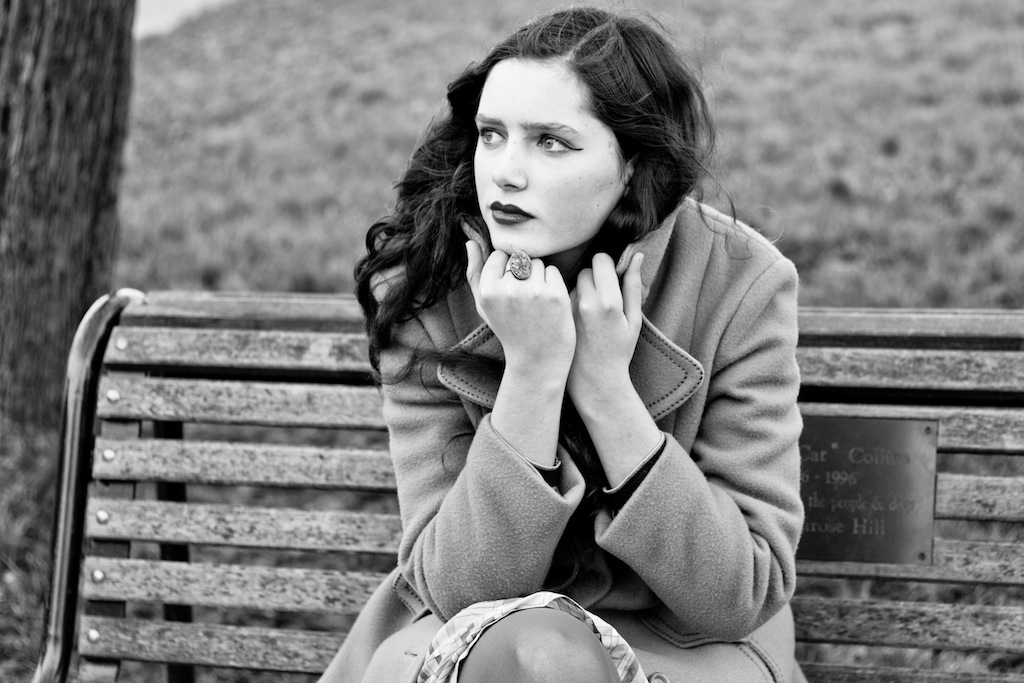
The following article was first written for Young Minds, so apologies if you read it back in December. I lightly edited it for re-publishing here. I felt that the photos taken of me by the multi-talented and rather gorgeous Lucy Feng (who I put in front of the lens here) last Autumn were appropriate on two counts - not only in the general energy and joy of the shots, but also in my proximity to a body of water. Everything worn is second hand. 

Dad went swimming recently – a brief, mad dash in and out of the freezing hillside pool. I crouched on the rocks above with my camera in hand trying to frame the moment, to capture him in the green cocoon of running water. I squinted through the eyepiece as he squealed. The winter stream was bitterly chilly, but I forced him to stay until I could focus and click. As he jumped out and reached for the towel I had a brief snatch of elation, of realizing quite how special these small moments still are. 

Little over a year ago my dad wasn’t dipping as much as a toe into cold water. This was unusual for a man who usually celebrated the delights of mountain streams and plunge pools regardless of season or temperature. The other three of us often watched as he slid in and out of lakes or rivers, his long legs kicking up as he laughed with the adrenaline rush. Roger Deakin’s ‘Waterlog’ was his guiding text, the outdoors his cathedral. The swimming stopped at the beginning of autumn 2011. Long walks, days out and that fascination with the beating heart of forests and hills gradually disappeared too. 

Depression was the diagnosis – the word he was given to explain why he could no longer function; the word that was offered to my brother and me to justify why our dad would be moving temporarily out of our home and into hospital; the word handed to my mum to help her understand why her husband’s eyes were empty. That word has become misappropriated and misunderstood in every day language. It is a clinical term, describing an illness that debilitates both mind and body. It is not interchangeable with sadness, despondency or any of the other more easily defined emotions. ‘Sadness’ doesn’t hang like fog in the living room for six months. It doesn’t give justice to the man whose head was full of terror, hands trembling as he ate, speech devoted only to paranoia and apologies. ‘Sadness’ wasn’t what created an impassable void between our father and the figure that sat on the sofa all day. This shape looked like dad, but had none of his curiosity or humour. It huddled reading trashy books and filling out sudokos day after day as we tried to coax him out. I imagined the real man outside somewhere, sculling up and down a river or strolling through a field at twilight, as he used to do. The outdoors scared this replacement. When we went away to visit friends he pleaded with us to let him out of the car, to leave him behind, to let him walk back home. Our house was a cave, with everything beyond the walls and windows threatening.

It’s very easy if you're on the outside looking in on depression to use blithe instructions like ‘pull yourself together’ or ‘stop moping’ or ‘use your willpower.’ But this is as impossible and insensitive as suggesting to someone with two broken legs that they should simply pull themselves together, get up, go for a run and then do something useful. The impact is as physical as it is mental and emotional – and it radiates out from the individual to affect all who surround them. 

Severe depression took all that my dad loved and lived for, and warped it. The chemical imbalance in his brain made literature unreadable and the landscape unreachable and terrifying. For him each stretch of water was no longer an embrace, but a place filled with possible dangers: broken glass and barbed wire waiting at the bottom or hidden currents that might pull us under. He didn’t need the adrenaline from jumping in the sea, his system already full of it from the constant horror and panic of ‘fight or flight’ as he sat on the sofa. He tried to fold himself away there, but couldn't curl small enough to pass unseen. We saw, and it hurt.

Depression is a wound of sorts. It can eventually heal – although the process of recovery may be one of complications and setbacks. Getting better is also a different process for everyone. The possibility of my dad’s return became clear on the afternoon he agreed to join me for a walk. Our conversation was stilted, but the steps were progress. Like a tide, the extent of the following revival varied from day to day. He moved from activity to monosyllables as moods shifted. But if the stroll was a first sign, then the revisiting of a favourite river was a decisive signal. It’s not melodramatic to say that when he was so ill, neither my mum nor I could imagine him ever swimming again. The idea was incompatible with the reality we had all coped with for months. Nonetheless, there he was – hollering with as much energy as remembered, lips grinning beneath a striped beanie hat.

His depression officially lifted in late spring of last year, after much trial and error and ongoing combinations of approaches for managing and treating it. It now strikes me that his illness left him stuck at the bottom of a silted lake. We wanted, desperately, to catch him with hooks, suddenly yank him from the depths – dredge him up in an instant. Instead it was an agonizing process of waiting for the dark liquid to drain away, drop by drop.

That liquid is now not dark, but clear. The riverbed is sandy and covered in stones. Dad made up for lost time through cycling, writing and taking me on six-mile walks. Although it is now cold, he still retains this spark – a desire to fill himself up with life and the joy of being here. Whenever he now steps into a mountain plunge-pool, with breeze ruffling leaves, it is an act of celebration. A celebration of swimming; of the human ability to suffer and recover; of the wonder to be found in days out and other activities; of the bonds between family; and of the relationship with the outdoors.
We all push forward, taking it one stroke at a time.

Monday, March 11, 2013

I Am The Spring


Boden dress styled in the first instance with a second hand hat and pair of wedge heels, and in the second with shorts from a charity shop, a necklace made by Maya, my favourite ankle boots and a Persephone book. 

What does a love of florals say about a person? Possibly nothing of great significance beyond a penchant for petals and colourful patterns. But it remains a universal symbol, worn by everyone from Grace Kelly to (apparently) the suffragettes; a print of continuing endurance – encompassing everything from the smallest of sprigs to the largest of abstract splashes.
Florals can appear passive at times – sweet, charming, out of reach of mud and grass stains. Indeed, the prevalence of roses and daisies on fifties' day dresses may suggest that they are purely the domain of the pretty. However, just as there is something in the region of 250,000 varieties of flowering plant in the world, so the floral print has more forms than one could wear in a lifetime. The bold, red splash of poppies; the embroidered intricacy of multicoloured chrysanthemums; the monochrome restraint of grey and white blossom scattered across a skirt. The realistic rubs fabrics with the outlandish. Flick through any book on vintage trends and there will be a profusion of flowers, from the imposing shapes on a thirties evening coat to the busy fabric of a Laura Ashley smock.
The interlinked history of florals and fashion may stretch back to when the first flower was tucked behind an ear, but achieved popularity in the 20th Century. As methods of printing became cheaper and more effective, the concept of leisure grew large in society – leading to a spate of tea dresses rippling with flowers during the 50s. Brands such as Horrocks are now famous for their functional floral creations, whilst designers such as Hubert de Givenchy, Cristobel Balenciaga and Christian Dior often took the structure, colour and effect of flowers as inspiration for the cut and pattern of their clothes.
At the moment the current SS13 collections are blooming, with Prada, Erdem (inevitably), Moschino, Zac Posen and the inimitable Corrie Nielsen, among others, making use of the floral motif. There’s a hardy endurance there. The love of flowers on clothing is deep-rooted, popping up as a trend every few seasons like newly sprung seedlings. Sometimes what follows is an article in a publication on the ‘perfect’ floral dress, as though there is a single, elusive one out there – hanging expectantly as it waits for a warm body to give it shape.
I’ve been lucky enough to find several. One is a vintage 70s dress cut tight to the torso and covered with rounded blue and brown flowers. Another is a 60s gold cocktail dress with blue roses stretched across the surface. A third is a black mini-dress covered in pink and orange petals, belted at the waist and flared slightly at the hem. I wore it to the Royal Festival Hall on the South Bank in London on Friday to celebrate International Women’s Day. I was a feminist in a floral dress and it felt good.

But the latest floral addition is this Boden beauty, chosen to celebrate Stylist offering a £500 giveaway to one fortunate reader. It was difficult to pick from the selection of Boden dresses on offer, but from the knee length dresses this print dress (Riviera shirt dress in Steel Flower Pop) has a special resonance. It reminded me of a Brettles housecoat I became smitten with several years ago: light pink linen with deep pink, almost crimson flowers, it was the kind of item one would want to lounge around in drinking cocktails and having informal dinner parties. Perhaps this says as much about my aspirations as my preferred aesthetics, but similarly here the wide skirt, lilac cotton and shirt dress design brings with it plenty of potential. The neat pattern encourages thoughts of picnics and afternoon tea, lounging in the grass or stretching legs across the lawn on warm, summer evenings as the light fades. It is a dress of idealism, as well as a practical item to wear repeatedly once spring hits its stride. 

Thursday, March 7, 2013

Homage to Orla Kiely


A plain door and flashed ticket lead to
ladder-steep stairs.
On the upper floor, desks;
where pastel secretaries tap and file.
Light brims over the clatter of keys,
a corridor of motion.

Boucle suits and t-bar shoes with polished heels and toes,
Mohair jumpers pink and soft as typists sit in rows.

Filing cabinets stacked
in blocks – a backdrop to
phones and teacups,
lamps, moneyboxes, beehives
shifting as they stoop and turn.

Cabled dresses, squirrel jumpers, jaunty circle skirts
All revealed as coats are peeled and sleeves rolled up on shirts.

We watch,
weight balanced on one metallic heel
or placed equally in two patent boots,
clustering at the edge.

They gather in a throng of knits as klaxons mark the close,
The working day has faded to a final, knock-kneed pose. 

Easy to imagine them still
typing, talking, working, walking
in a pocket of time,
suspended above Flitcroft Street:
hanging on the hem
of the past.

Rosalind Jana, 2013 


Photos of the Orla Kiely presentation very kindly provided by the beautiful Dina of She Loves Mixtapes

London Fashion Week is often described as a circus, but the more appropriate location might be the fairground. Colourfully dressed crowds; catwalk spaces strung out across the city like stalls displaying their wares; the spectacle of the shows and presentations. At LFW the Ferris wheel is not a physical presence, but an apt metaphor for the tumbling, ever-turning motion of each day as buyers and press make their way from place to place. Others are less concerned with the designers’ attractions than with the attendees – streets taking precedence over the catwalk as outfits are observed, aligned in the frame of a lens, quickly shot.

The increasingly theatrical aspect of London Fashion Week was most clearly encapsulated in Orla Kiely’s presentation in the Elms Lester gallery on Flitcroft Street. A mise-en-scene of desks, typewriters and beehived models greeted viewers who climbed the stairs with invites in hand. The whole experience was a multisensory immersion into another age - the taste of champagne and the sound of phones ringing balanced against sights of mustard cardigans and peter pan collars. It was an irrepressibly charming performance in situ. The line between stage and the audience blurred as we watched the 60s style typing pool from the sidelines – many with cameras in hand, or in my case a welsh-wool covered notebook and pen.

There is something incredibly desirable about the clothes that Kiely produces each season. They represent a full-skirted, pastel-sweetened vision of youthful elegance. Ankle socks abound in the lookbook, while during the presentation, white tights flashed past as models walked, sat and giggled behind carefully manicured nails. As with all collections, the overall theme can be broken down into individual designs – Mondrian-esque block print shift dresses, velvet jacquard jackets, pink dvore pencil skirts. The floral sprigged shirts and grey, faux fur coats will no doubt be desirable to a wide audience. A few consumers might emulate the playful office feel of the presentation, but these are all items with individual versatility and longevity. The presentation was a beautifully staged chance to set the clothes in motion and to assemble a story around the designs. 

And yet there’s something interesting about the role of women in these narratives. The crisp chic of a 50s secretary does have its allure – not only in the tailoring, but also in the whiff of stationary and thorough organisation. Add in the evocative clack of typewriter keys, the colour co-ordinated office space, the industriously stacked filing cabinets and you have a space that harks back to the world of Mad Men or The Hour. But despite the perceived glamour and style of such settings, the reality is that few would now aspire to being an ‘office girl’ - as they once did - or to working in such a retro environment. After all, the corsets and girdles worn under nipped-in dresses in the 50s and 60s were symbolic of the restraints placed on women at the time.
We are fortunate enough today (in the West) to live in a society where all jobs and roles are technically open to us – much higher rungs on the ladder to reach for if so wished (if not always achievable due to other factors.)
Perhaps it’s a process of drawing out the differences between inspiration and idealising of a past reality. Taking an era or look as stimulus for the creative process does not necessarily translate into a desire to live in that time period. We can acknowledge the allure of pencil skirts and sweaters as Orla Kiely does so gloriously, whilst also noting that we’re lucky now to be able to make an active decision to dress like this – treating the aesthetic as one of a myriad number of options, rather than a narrow given.

My slight homage to Kiely's AW '13 collection was composed of a second hand vintage blazer and cashmere jumper (both charity shopped), blue shirt from my mum, a second hand Valentino skirt (present), shoes from a charity shop and vintage accessories. 

If you want to see more of my writing, head over the the brilliant All Walks on the Catwalk website where I wrote an article about my experiences of modelling and body image. 

Popular Posts